How can Nature-based Solutions unlock new opportunities for rural areas?
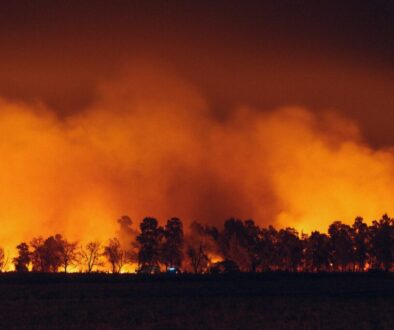
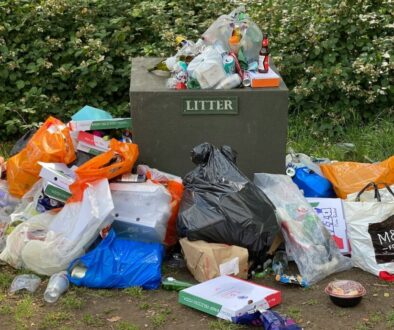
The UK has been described as “one of the most nature-depleted countries on Earth”. ‘Nature‑based Solutions’ (NbS) are actions to protect, conserve and restore the natural world while simultaneously benefitting society. NbS range from preventing greenhouse gas emissions from peatlands to natural flood management and reforestation with native species. While the UK Government expresses support for NbS in responding to climate change, the Office for Environmental Protection (OEP) has cautioned that declining habitat condition and the spread of invasive species pose challenges to long-term climate resilience. Rural communities are increasingly exposed to more frequent flooding, water scarcity and soil degradation, adding to the growing pressures on land for food, energy, housing and nature recovery. Businesses also face rising operational and financial risks as climate impacts and nature loss disrupt supply chains, increase resource constraints and expose firms to tighter regulation. This situation raises a key question: can NbS support a thriving, nature-positive rural economy – and what does this require? Jessica Sellick investigates.
The International Union for the Conservation of Nature (IUCN) founded the concept of Nature-based Solutions (NbS) some 20 years ago, developing a formal definition as “actions to protect, sustainably manage and restore natural and modified ecosystems in ways that address societal challenges effectively and adaptively, to provide both human well-being and biodiversity benefits” – with this definition formally adopted by the United Nations at its fifth Environment Assembly in 2022 (UNEA-5). Regarding projects or initiatives, NbS is described as ‘harnessing the power of ecosystems to benefit people, nature and climate’.
Back in the UK, in July 2025, the Environment Agency published a position statement on NbS, adopting the IUCN/UN definition and describing how this could be implemented ‘across a range of landscapes from urban to rural, upland to lowland and in coastal and estuarine locations. They might range from small scale changes in a single field to much larger schemes across a catchment or along a coast’. Practical examples of NbS include floodplain restoration, wetland recovery, regenerative agriculture, woodland creation and soil health interventions.
With UN Environment Programme’s (UNEP) latest Global Environmental Outlook calling for a ‘whole of government’ and ‘whole of society’ approach to addressing the shared issues of climate change and biodiversity loss – including calling on countries to deploy NbS – what domestic action and progress is taking place, and what does this mean for rural areas?
Why do Nature-based Solutions matter now?
In February 2025, the Government and devolved administrations published a UK Biodiversity Strategy and Action Plan (NBSAP) which set out how “biodiversity is key to all the processes that support life on Earth. We rely on it for our essential needs, like food, shelter, energy and medicine, as well as for the ecosystem services it provides, such as climate regulation, flood management, water purification, disease and pest control, and pollination. Additionally, more than half of the world’s gross domestic product (GDP) (equivalent to estimates of between $44 – 58 trillion) is highly or moderately dependent on nature” (page 10). The Government also cited the findings of the State of Nature report (2023) which revealed:
- A 32% decline in species’ abundance: the abundance of 682 terrestrial and freshwater species has, on average, fallen by 32% across England since 1970. Within this general trend, 316 species have declined in abundance (46%) and 161 species have increased (24%).
- An 18% decrease in the distributions of invertebrate species: the English distributions of 4,815 invertebrate species on average have decreased by 18% since 1970. Stronger declines were seen in some insect groups which provide key ecosystem functions such as pollination (average 22% decrease species’ distributions) and pest control (40% decrease).
- Decreases in the distributions of over half of plant species: since 1970, the distributions of 64% of flowering plant species and 68% of bryophytes (mosses and liverworts) have decreased across England.
- 13% of species are threatened: of 8,840 species in England that have been assessed using IUCN Red List guidance, 13% have been classified as threatened with extinction from Great Britain.
The Joint Nature Conservation Committee (JNCC) publishes figures assessing biodiversity trends in the UK. The latest update was published in December 2025 and includes 39 indicators comprising 68 measures. The results show:
- Over the long term, many indicators have shown improvement, reflecting sustained positive changes in some aspects of biodiversity. However, many have also deteriorated, reflecting ongoing pressures on ecosystems. A smaller group of indicators has remained broadly stable over time.
- Of the indicators which are deteriorating in the long term, none are showing improvement in the short term, suggesting that we are yet to reverse the negative trend in many aspects of biodiversity. However, some have stopped deteriorating in the short term, suggesting that some long term negative trends have stabilised.
- Many indicators already showing improvement in the long term continue to improve in the short term. However, some progress has stalled or even deteriorated in the short term.
Alongside this, the NBSAP describes how “globally, nature and the contributions it makes to humanity are under severe threat”, how “biodiversity is declining faster than at any time in human history” and that in the UK, ecosystems “remain affected by environmental pressures, including climate change and pollution”.
NbS are seen as offering opportunities to simultaneously address climate impacts and improve biodiversity, while also creating societal benefits. The UK’s policy landscape is now shifting in ways that make NbS more central to future land use – with initiatives including the Nature Restoration Fund and Biodiversity Net Gain (BNG).
Since Brexit, farm support in the Uk has been changing. Funding for farmers, growers and land managers seeks to manage land to benefit the environment. Examples include:
- Sustainable Farming Incentive (SFI): this pays farmers and land managers for sustainable land management activities that protect and benefit the environment, support food production, and improve productivity. Funding guidance has been published for windows opening in June 2026 and September 2026 along with confirmation of the offer for SFI26.
- Countryside Stewardship Higher Tier (CSHT): this supports farmers, foresters and land managers to manage their land in a way that protects, restores and enhances the environment, improves biodiversity and water quality, and helps tackle the effects of climate change. Defra’s initial approach in 2024/25 was to gradually bring people into CSHT by rolling out invitations each month – this controlled, invitation-only rollout has continued in 2025/26.
- Capital Grants 2026: opening in July 2026, this will make £225 million available to farmers, land managers and rural businesses to deliver environmental improvements. Eligible items are organised into the following groups: boundaries, trees and orchards; water quality; air quality; natural flood management, assessments, and improvements.
- Farming Equipment and Technology Fund (FETF): funding to help farmers, horticulturalists, foresters or contractors to buy items to improve productivity, manage slurry and improve animal health and welfare. The last window opened on 17 March 2026 and closed on 12 May 2026.
- Farming in Protected Landscapes programme (FiPL): offers funding to farmers and land managers in National Landscapes, National Parks and the Broads to support nature recovery, mitigate the impacts of climate change, provide opportunities for people to discover, enjoy and understand the landscape, and protect or improve the quality and character of the landscape. The Year 3 Review contains more information about how FiPL works and examples of projects in action. Applications are open until March 2029, but will close sooner if all funding is allocated.
SFI, CSHT, Capital Grants, FETF and FiPL are all intended to support the rural economy while achieving goals set out in the 25 Year Environment Plan and the Environmental Improvement Plan. Nature markets can also provide an additional source of income as organisations look for new ways to meet environmental goals (e.g. North East Carbon and Nature Marketplace enables organisations to invest in local carbon-saving projects). More recently, the Land Use Framework for England (published in March 2026) adds a new layer to this strategic direction, arguing that England has ‘enough land’ to meet climate, nature, food and development needs — but only if decisions are made in a more integrated, data‑driven way. The Framework also contains a commitment to “making land digital”, signalling a future in which NbS may become easier to plan, justify and invest in.
How can NbS drive a nature-positive rural economy – and at what scale?
This shift to NbS is driven not only by environmental need but by commercial reality. Back in 2017, the Departments of biology and geography at the University of Oxford established the Nature-based Solutions Initiative (NbSI), to conduct interdisciplinary research and provide guidance for decision makers. A recent policy briefing describes nature loss as a material business risk – highlighting how water stress, soil degradation, climate volatility and biodiversity decline are already disrupting supply chains and increasing operational costs. Similarly, regulations are tightening — most notably through the UK’s new UK Sustainability Reporting Standards (UK SRS). The UK has endorsed and adapted the global ISSB standards, creating UK SRS S1 (general sustainability disclosures) and UK SRS S2 (climate‑related disclosures). Finalised in early 2026 after public consultation, these standards are currently available for voluntary use, but the Government and the Financial Conduct Authority (FCA) are actively considering making them mandatory for large and listed companies – with a phased implementation approach proposed from January 2027. Indeed, many large firms already publish detailed disclosures on climate-related risks, governance, strategy and metric – in line with the FCA’s Task Force on Climate-related Financial Disclosures (TCFD) which came into effect between 2021 and 2024. Moreover, some companies disclose climate risks voluntarily because investors, lenders or customers require it (e.g. JCB, Arla, Tetra Pak). In this context, scaling NbS across landscapes is becoming a core commercial necessity for future-proofing operations and assets, rather than a discretionary or charitable activity or feel-good add-on. Rural areas are uniquely positioned to realise nature-positive actions, as they hold the majority of the UK’s natural capital and offer the greatest scope for investable impact.
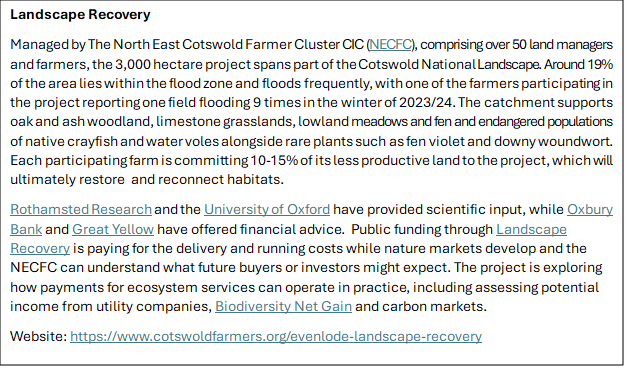
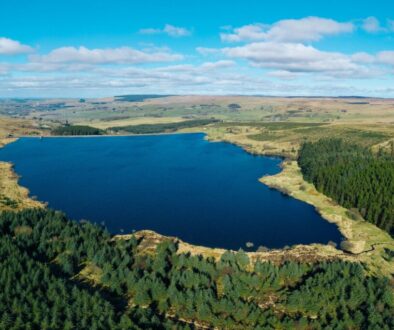
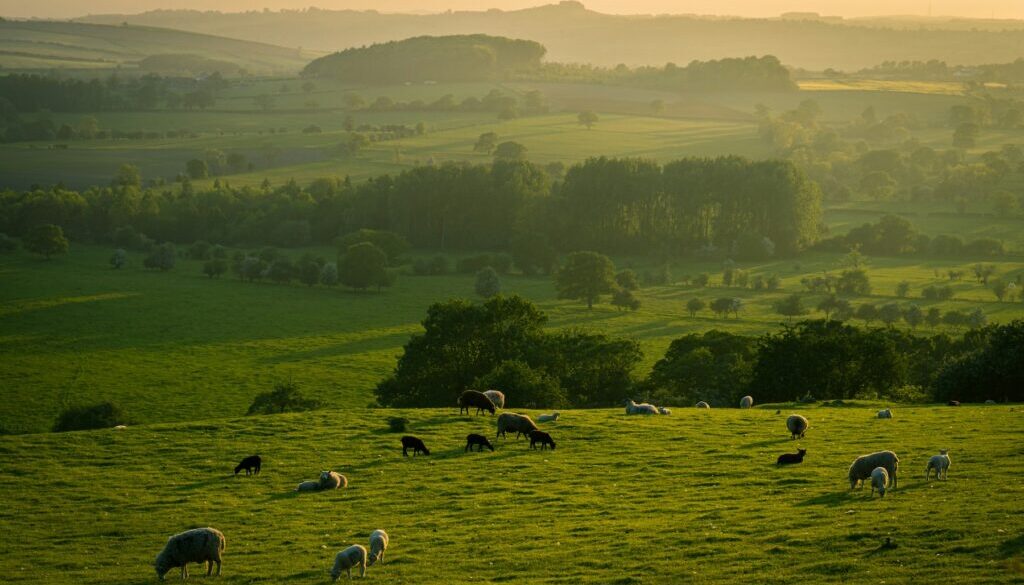
In terms of opportunities, rural landscapes are the primary delivery environments for NbS: from large‑scale peatland restoration and woodland creation to river‑catchment management and regenerative agriculture; all require space, continuity and long‑term stewardship that rural areas can provide. Rural areas also hold a disproportionate share of the UK’s natural capital — including much of its agricultural land, woodlands, protected sites and reservoir capacity, leading academics at the University of Exeter to describe them as “strategically important landscapes, home to natural infrastructures of national significance”. Landowners, farmers and land managers are central delivery partners, and their expertise is increasingly recognised as essential to designing and implementing effective NbS. Blended finance models, combining public funding with private investment and community ownership, are emerging as powerful tools to anchor value locally. Restored landscapes also support tourism, recreation and local wellbeing, while the expansion of NbS creates new employment opportunities in land management and environmental monitoring.
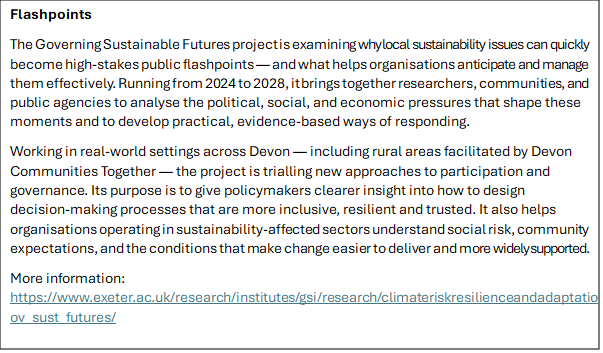
In terms of challenges, land‑use trade‑offs remain sensitive, particularly where food production and habitat restoration appear to compete. Although Landscape Recovery pilots show that multi‑functional land use is possible, concerns persist about land being taken out of production or consolidated by large external investors. Indeed, the contribution rural areas make to ecosystem services – and rural-urban linkages – is frequently under-valued and under-resourced in policy and investment circles. Revenue models for NbS are still maturing, and farmers face uncertainty over long‑term prices, verification costs and contractual obligations – and are requesting more information, support and coordination. Monitoring — essential for credible nature markets — requires digital infrastructure and technical skills that are unevenly distributed. Recent research highlights persistent monitoring and capacity gaps — including fragmented data, limited access to tools, and technical barriers. Communities may also express concerns about access, landscape change or the role of external investors, particularly where projects are not co‑designed with and for them. There are real risks here too that environmental responsibilities are shifting onto rural areas without the equivalent investment or local benefits (e.g. where biodiversity obligations from urban development are fulfilled on rural land, yet the economic benefits are captured elsewhere). This can undermine social legitimacy, creating mistrust that slows or blocks future projects.
Overall, the current approach to NbS is often seen as fragmented and siloed. Indeed, Tony Juniper (Chair, Natural England) describes how the UK has never had a truly integrated spatial plan for land, water, nature and carbon:
“ [NbS] won’t work everywhere in the same way, they have to be based on the specificity of the places, and to be using the opportunities that exist in those places to get good outcomes. So we need spatial planning. We’ve not had that in this country. I mean, the planning system that we have was invented in the post war years. It was about development and urban sprawl. Nobody was really planning for agriculture or the forestry or the Nature, not in a systematic, national way. And they certainly weren’t planning for carbon or climate change adaptation, but now we can hopefully embark on the journey that takes us into that space, and can begin to give us the opportunities to bring genuinely joined up integrated solutions to the many challenges that we face, and there are many, not only the Nature and climate crises, but we need to feed ourselves, we need to renew some of our infrastructure, and we need to build a lot more houses”, Speech by Tony Juniper, Natural England, February 2025.
Government policy is reinforcing this direction of travel – not only through environment and land use policies, but also through accelerating changes to planning (e.g. Planning and Infrastructure Act 2025, proposals to bring forward statutory guidance for a national scheme of delegation and size of planning committees by September 2026, revising the National Planning Policy Framework, consulting on proposed geographies over which Spatial Development Strategies should be produced, consulting on proposals for Local Planning Authorities to consult the Secretary of State where they are ‘minded to refuse’ planning applications and New Towns Draft Programme). Similarly, Local Nature Recovery Strategies are promising but not yet fully integrated with planning, agriculture or water, with responsibilities scattered across agencies. Will a focus on building housing, biodiversity streamlining, and preferential treatment for projects which improve or strengthen local services and economies benefit NbS, or will it lead to fast tracking development at the expense of rural communities and a piecemeal approach that neither maximises environmental outcomes nor supports rural economies?
Moving forward, what would a nature‑positive rural economy look like if rural communities were placed at the core of NbS? For me, it would have the following characteristics:
- Community led governance and fair benefit sharing: NbS projects must be co-designed with local people so that as many environmental, social and economic benefits as possible stay within rural areas. Parish Councils, local organisations, farmers and landowners and residents should all shape priorities and delivery. Local authorities, catchment partnerships, internal drainage boards, the ACRE Network and other local and regional governance bodies should act as convenors and brokers, ensuring that investment aligns with local needs and strengthens wellbeing, resilience and services. Local ownership and decision-making needs to remain central as nature markets grow.
- Integrated spatial planning and land use coordination: food production, housing, infrastructure and nature recovery should reinforce each other rather than compete. A coordinated approach to land stewardship – across planning, agriculture, water, environment and generations – would reduce conflict, unlock efficiencies and support long-term rural prosperity.
- Deliver diverse and resilient income streams for farmers and land managers: farmers should be able to combine food production with income from flood-mitigation contracts, habitat creation and management, carbon and biodiversity credits, tourism, leisure and forestry. This diversification stabilises rural incomes, reduces exposure to commodity volatility and supports long-term stewardship. But to make this viable, farmers need confidence: long-term price stability, clear regulatory signals and standardised metrics. Indeed, a report from the Committee of Public Accounts (March 2026) concluded that farmers lack sufficient guidance to comply with environmental regulations – with forthcoming changes to ELMs and the proposed new water regulator adding further complexity.
- Monitoring, verification and environmental management are rural economic opportunities: these fields could become significant employment sectors. Investing in training and skills would enable rural communities to develop specialist expertise in ecology, hydrology, surveying and land management. This requires digital and data infrastructure to be in place.
- High quality nature infrastructure alongside hard infrastructure: woodlands, wetlands, peatlands and restored catchments should be treated as essential infrastructure that reduces long-term costs (e.g. reducing flood risk, improving water quality).
- Balancing calls for landscape-scale initiatives with individual site-level actions: while larger-scale areas are often needed to attract investment, small-scale interventions are equally important. A successful NbS economy values both the strategic and the granular.
- Clear roles for business: major retailers, food processers, utility providers, insurers and infrastructure operators have an increasing interest in NbS. Their involvement – through co-funding, long-term contracts, risk sharing and supply chain standards – is essential to scaling NbS.
- Scenario modelling to guide choices and manage trade-offs: future land use scenarios help stakeholders understand synergies and trade-offs early. The RSPB’s Land Use Scenarios project, which has modelled 10,000 different future land use situations, shows how very different approaches affect nature, food production and net zero – showing why accelerating NbS delivery is essential.
- National evidence base: Rural NbS delivery is hampered by gaps in data on nature, land, ecosystem services, skills and governance. A national rural NbS programme would support better decision-making and more targeted investment.
Taken together, these elements show that NbS can indeed underpin a nature‑positive rural economy — but only if the enabling conditions are in place. This requires a stable and coherent policy framework that aligns communities, agriculture, environment, planning and health; long-term and trusted investment structures, where nature markets have clear rules, price stability and robust verification; and local capacity and safeguards so that rural communities shape decisions, retain benefits and are protected from unintended consequences. When these conditions align, NbS can deliver environmental gains while strengthening rural communities and economies.
Where next?
NbS offer one of the few approaches capable of reconciling competing demands by delivering multiple benefits from the same piece of land and across landscapes. The next phase of NbS will be defined by an improved evidence base and more consistent, decision-ready monitoring. Indeed, The Nature Positive Initiative and WBCSD are now leading the development of a global Biodiversity Monitoring Protocol, due this year, which will give companies a standardised and credible way to measure and report nature impacts across their supply chains; and Natural England’s Nature Returns initiative is building the domestic evidence base needed to understand what works, where, and at what cost. Indeed, Defra is moving away from traditional conservation approaches which have focused on protecting species and habitats to functional ecology and the processes that enable ecosystems to adapt to changing conditions. This includes domestic priorities covering spatial planning decisions, the targeting of agri-environment funding and protecting areas for biodiversity. All of these developments signal a shift from pilots to performance — from scattered projects to measurable, accountable, investable and scalable outcomes.
NbS are not a silver bullet, but the opportunity is real: rural communities stand to gain economically, socially and environmentally if policy, business and local leadership pull in the same direction. In this context, NbS need to be viewed as essential national infrastructure, not an optional environmental add on. The question is no longer whether NbS can deliver a nature‑positive rural economy, but whether the UK will create the conditions that allow them to do so.