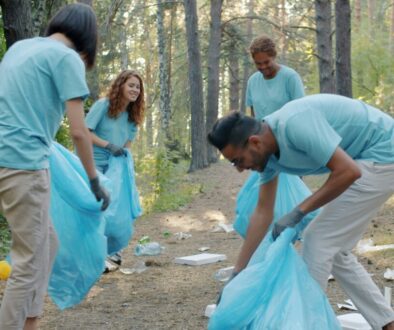
The importance of rural volunteers
From providing services in your local community to doing whatever is required to help out, understanding the social value of volunteering is now finding its way onto the policy agenda. What traditional and newer measurement approaches are emerging and what do they mean for rural communities? Jessica Sellick investigates.
Back in October 2014, Bank of England chief economist Andy Haldane gave a speech at the launch of a digital volunteering service where he said that the value and importance of volunteering was undervalued because it was not reflected in official statistics.
He said: “The UK’s army of volunteers is huge but the value of volunteering is often underestimated. Policymakers, focused on official statistics like GDP, will miss it entirely. If we were to value just the hours donated the UK voluntary sector would be worth in excess of £50 billion…
“But even this could be an underestimate and the total value of volunteering to society is likely to be larger still. Although few charities have the opportunity to undertake cost-benefit analyses, those that have suggest the wider benefits of their work are many times their total costs.”
While recognising the Government’s proposed three days paid volunteering leave and the National Citizenship Service as good ideas, Mr Haldane suggested more needed to be done to “nudge people into volunteering”.
In a BBC Radio 4 Programme ‘volunteer nation’, Mr Haldane explained how an estimated 15 million people volunteer on a regular basis in the UK – with this figure rising to 30 million people when you include those who give their time and effort in more sporadic ways over the course of a year.
This volunteer army is estimated to offer 4.4 billion hours of work per year (equivalent to almost 10 per cent of the paid hours worked in the UK). Adding in informal volunteering might double those numbers – equivalent to the number of people employed in manufacturing across the whole of the country.
Volunteering, then, is now being viewed as big business. But what is the nature and extent of rural volunteering? And what does it mean for communities, policy and decision makers? I offer three points.
Firstly, what is volunteering and does it have a rural dimension?
The International Labour Organisation (ILO) defines volunteering as: “unpaid, non-compulsory work; that is, time individuals give without pay to activities performed either through an organisation or directly for others outside their own household”.
Volunteering is also categorised as ‘formal’ or ‘informal’ with the Scottish Government defining formal volunteering as ‘‘the giving of time and energy through a third party, which can bring measurable benefits to the volunteer, individual beneficiaries, groups and organisations, communities, environment and society at large.
It is a choice undertaken of one’s own free will, and is not motivated primarily for financial gain or for a wage or salary” and informal volunteering “as helping a friend or a neighbour in a self-managed way, e.g. helping them with some gardening or watching their home…”
The British Household Panel Survey (BHPS) has asked 5,500 households across the UK about the nature and scale of their volunteering activities. If extrapolated, the data suggests volunteering in the UK might amount to as much as 4.4 billion hours per year equating to 1.7 hours per week for every UK adult aged over 16 years.
The survey found volunteering to be more prevalent among older people. Data published by NCVO in June 2015 found levels of ‘formal volunteering’ declined at the start of the recession, increased during the recovery and is now stable.
The picture is similar for ‘informal volunteering’ with the data suggesting in 2013-2014, 64% of adults reported volunteering informally at least once in the last year and 35% doing so at least once a month, with levels remaining static since 2001.
However, rural urban differences in the type and frequency of volunteering have emerged. Back in 2007, NCVO published a report considering how volunteering meets the needs of rural communities.
This identified a series of rural characteristics which impact upon volunteering levels – these were: dispersed populations, small settlement sizes, transport challenges, less comprehensive service provision, higher costs per head of service delivery, distinct demographic make-up and potentially hidden deprivation.
More recently, research by SRUC found volunteering activities in rural areas tended to be service based (e.g. providing services, providing transport) as well as more generalist (i.e., doing whatever is required or generally helping out). This suggests rural volunteering is broader and spread across several roles or activities compared to urban volunteering which is focused on fewer and more specific activities.
Taken as a collective, this data and research reveals how (formal and informal) volunteers in rural places are addressing multiple issues that manifest themselves in that place.
Secondly, how can we measure the value of volunteering and the contribution that they make to rural places?
Measurement’ matters because it helps us know what works and understand why; develop a ‘moving picture’ of the distance travelled; and provides us with a more rounded view to help us balance economic, social and environmental trade-offs. At the same time, as the chief economist at the Bank of England indicated, hard data (facts, trends and survey data) and official indicators neglect volunteering.
This can lead to narrow, output-focused, low cost approaches instead of measuring the outcomes that matter most to people and communities. So how can we measure the value of volunteering to the volunteer, recipient of their voluntary activities and to society?
Some economists are starting to recognise volunteering as work – for it involves producing goods and services outside of your own household (e.g. taking your neighbours shopping or to the hospital). Similarly, charities are starting to work with economists to quantify and demonstrate the impact of their interventions.
This work tends to focus on ‘formal volunteering’ – perhaps because the informal volunteering is the bit that can be harder to measure?
In 2014-2015 I was involved in ‘VERSO’, a European project to research and map out ways to combat unemployment through volunteering.
This involved developing a set of financial proxies that could be used to estimate the social return on investment. The proxies, developed with the University of Gloucestershire, East Riding of Yorkshire Council, tested with projects and triangulated with European partners included:
- The value that frequent volunteers place on volunteering (£14,604 per person) – derived from a HM Treasury-Department for Work and Pensions Discussion Paper by Fujiwara and Campbell in 2011 and now incorporated into HM Treasury Green Book.
- The value placed by a local authority on volunteering (£11 per hour) – taken from Vale of Glamorgan Council report on the economic value of volunteering.
- The value of a volunteer in the UK (£1,666 per volunteer) – derived from the Institute for Volunteering Research Community Life Survey.
While these proxies rely upon secondary, non-statistical sources, they recognise how volunteers and volunteering is not free and move us closer towards measuring and understanding the contribution their activities make to society. Equally and depending on the activity, volunteering entails expenses that need to be met.
Volunteers need to be supported, trained, insured and managed. And we need to look after our volunteers to make sure they are not overwhelmed and reaching burnout.
Thirdly, if we can define volunteering and begin to measure and put a value on it, what does this mean for policy and decision makers?
The chief economist at the Bank of England signals the need to increase the visibility and quantification of volunteering. He also suggests supporting charities and voluntary and community sector organisations with the skills to capture the benefits of volunteering.
In a rural context, for me this means mapping what is already happening around volunteering at a local level, matching volunteers to activities and developing capacity for further volunteering (where it is appropriate and sustainable).
This opens up a series of debates in a rural context as to whether ‘informal volunteering’ could become ‘formal volunteering’ and/or whether gaps in provision caused by public sector funding and service reductions can be bridged by volunteers.
But does this mean rural volunteers are ‘substitutional’ rather than ‘additional’ in nature– with SRUC researchers suggesting that substitutional activity may be less empowering and less sustainable.
It has further been suggested that we are moving from an ‘interventionist phase’ to an ‘infrastructure phase’ with volunteering seen as increasing important at a local level. Yet at the same time funding for infrastructure organisations to support volunteers is declining.
In 2013 I was a researcher on a Defra funded project looking at ‘alternative service delivery’. Government wanted to identify innovative approaches to the delivery of rural services developed by community and voluntary sector organisations (i.e., how they operate in practice, what the main successes and barriers are to their implementation in rural areas).
The resultant case studies highlighted how volunteering takes many different forms: from regular helpers, those volunteering in a short term capacity or for specific event, and those supporting a service but who do not recognise themselves as a volunteer.
In some rural communities there will not be (enough) residents with specialist and generalist skills, time and commitment to donate more volunteer hours to do more in and for their community.
In shifting the conversation as the chief economist does, from doing stuff in your local community on an ad-hoc informal basis to seeing how we might measure volunteering (and value it in official statistics) will this reduce the likelihood of people volunteering?
Or will more people in rural communities be encouraged to volunteer, particularly as public sector funding and resources continue to be reduced?
Jessica is a researcher/project manager at Rose Regeneration; an economic development business working with communities, Government and business to help them achieve their full potential. She recently completed a European project on ‘volunteering into employment’ and is currently helping Local Authorities, LEPs and charities to measure social value. Jessica is also involved in projects to help older people remain independent and in their homes for as long as possible. In her spare time she volunteers for a farming charity. Jessica can be contacted by email jessica.sellick@roseregeneration.co.uk or telephone 01522 521211. Website: http://www.roseregeneration.co.uk/ Twitter: @RoseRegen