How can we regenerate rural neighbourhoods, and should we consider revisiting ‘Total Place’?
Launched in 2009, Total Place involved 13 pilot areas with the aim of understanding how places could deliver better, lower-cost public services by eliminating duplication across organisations and breaking down silos. At the time, The Secretary of State John Denham estimated that adopting a Total Place approach could save up to £20 billion over ten years. Following the Autumn Budget 2024 and Spending Review 2025, Denham and other commentators are suggesting that this approach could be revisited to address the challenges of the mid-2020s. What lessons can we learn from the pilots, and what might Total Place 2.0 mean for rural communities? Jessica Sellick investigates.
………………………………………………………………………………………………..
Back in 2004, Local Area Agreements (LAAs) were introduced as a new form of contract between central and local government. The aim was to ‘deliver the priorities of local people through strong leadership and effective support from Whitehall’. Over a 3-year period, LAAs were expected to cover approximately £5 billion of public expenditure. LAAs were negotiated between Government Offices for the regions (GOs) and upper tier Local Authorities on behalf of Local Strategic Partnerships (LSPs). These agreements allowed funding streams from central government departments to local authorities, which were previously ring-fenced, to be pooled. Local decisions on spending were permitted as long as the outcome targets in the agreement were met.
In October 2004, 21 pilot LAAs were announced for implementation starting in April 2005. An additional 66 LAAs were signed in March 2006, and a further 62 in March 2007. This achievement met the Government’s target of having LAAs in every area in England (apart from the Isles of Scilly) by April 2007.
In October 2006, the Department for Communities and Local Government [now the Ministry of Housing, Communities and Local Government, MHCLG] and the nine GOs published a White Paper. This document outlined a strategy for sub-regions to collaborate with the Government to deliver joint priorities through Multi-Area Agreements (MAA). The specifications for these agreements were detailed in the Sub-National Review of Economic Development and Regeneration (SNR), which focused on reforms in four key areas: (i) empowering all Local Authorities to promote economic development and neighbourhood renewal, (ii) supporting Local Authorities to collaborate at the sub-regional level, (iii) strengthening the regional level, and (iv) reforming central government’s relations with regions and localities. Between July 2008 and March 2010,15 MAAs were signed in England.
In Budget 2009: Building Britain’s Future, section 6.35 outlined a ‘local incentives and empowerment’ workstrand to examine “how to provide the incentives for greater collaboration and innovation on the front line, with systematic front-line engagement alongside a reduction in burdens to create the space for progress. As a first step, the Government will launch the “Total Place” initiative, looking at public spending and local leadership in 13 local areas to identify how collaboration and prioritisation can lead to greater efficiency and value for money”.
In March 2010, HM Treasury and the Department for Communities and Local Government [now MHCLG] published a document outlining the Total Place approach. This examined 13 pilot areas and their achievements to date. This involved a comprehensive review of the financial inflows into each area, identifying obstacles to maximise funding, and strategies to eliminate inefficiencies and waste. The pilots addressed a wide range of issues directly impacting on people’s lives, including children’s services, substance misuse, housing, unemployment, asset management, services for older people, and offender management.
Much of the work carried out through MAAs and Total Place were integrated into Local Enterprise Partnerships (LEPs) when they were established in 2011.
In January 2024, Jim McMahon MP, then the shadow devolution and local government minister, proposed a return to Total Place should the Labour Party win the 2024 general election. While much has changed since 2009, some of the same challenges remain. Public services are under even greater financial pressures than they were following the 2008 financial crisis, and we are supporting more people than ever with long-term, chronic conditions. What happens when we consider public expenditure in terms of where it is spent, rather than which organisations spend it? Is now the time to revisit Total Place? Read on.
What is Total Place?
“Total Place involves local public services working together to deliver better value services to citizens by focusing on joint working and reducing waste and duplication…[it is about] how a place-based approach to local public services can deliver better outcomes and improved value for money…The pilot areas have a wide range of socio-economic and demographic characteristics, and different local authority structures” (HM Treasury & DCLG, Total Place, 2010, page 14).
12-month pilots were run in 2009-2010 covering 11 million people. This comprised 63 Local Authorities, 34 Primary Care Trusts (PCTs), 13 police authorities, as well as voluntary and community sector organisations (shown in the map below).
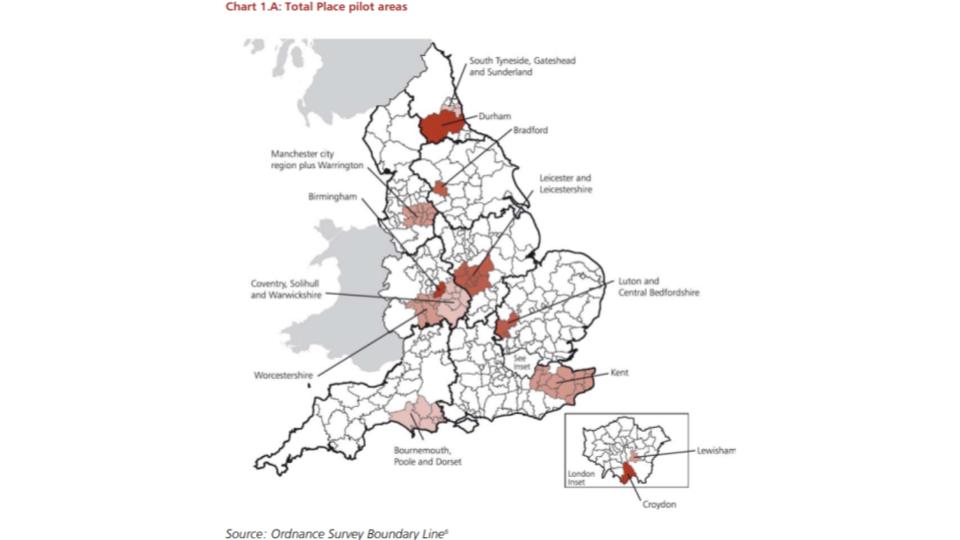
(HM Treasury & DCLG, Total Place, 2010, page 15).
Total Place comprised three strands:
- Counting: this involved mapping total public expenditure in a place, with a deep dive into specific local policy areas to discuss how money could be better spent.
- Culture: to overcome resistance to collaboration between different agencies that address the same problem in the same place.
- Customer insight: to understand and transform public services from the perspective of the people who use them.
As well as joining up services, Total Place also centred on early intervention services. The aim was to avoid costly crisis-management by investing upfront.
What happened in the pilot areas? The 13 pilot areas counted £82 billion of public spending within their areas – approximately one-fifth of total public spending in England at the time. Social security, education and health comprised over 70% of total spend in each of the pilot areas. For upper tier Local Authorities, more than half of their Government grant was ringfenced. Public spending per capita varied from just under £6,000 per year in Coventry, Solihull and Warwickshire, to £8,800 in Bradford and Lewisham.
“Total Place has exposed the complexity of the ‘internal wiring’ of public service delivery. The large number of individual grants, and poorly aligned objectives of similar services across different policy areas, can limit the ability of delivery organisations to join up services around users. Understanding where the funding lies and a focus on customers have proved powerful drivers for change. In concentrating on citizens and outcomes, rather than on organisation-specific assessments and targets, local partners in the pilots have increasingly looked beyond organisational boundaries to develop innovative public services. For many places this has been a radical change to their historical way of working” (HM Treasury & DCLG, Total Place, 2010, page 19).
Total Place required all public leaders to take a broader view of leadership in public services. This indicated the need for a common language, a shared culture, and new ways of working. The pilots revealed:
- How cultural differences are a constraint on professionals themselves, hemming them within their own budget circumstances and service norms, leading to siloed decision making.
- The need to invest in, and grow a multi-agency workforce, backed up by necessary technical infrastructure and cultural commitment to data sharing.
- The need to bring together national professional bodies to work collectively on issues, thereby saving time and energy.
- Frontline professionals should be empowered to target and tailor their services to localised market failure, taking realistic account of local economic conditions and prospects.
“Pilots pointed to the importance of a will, ‘permission’ and an ability to ‘think outside the box’ – to challenge orthodoxy, traditional practice, institutional boundaries, current budget arrangements and outcome targets”, (HM Treasury & DCLG, Total Place, 2010, page 60).
Pilot areas used ‘customer insight’ to better understand services from citizens’ perspectives. This included developing services around the needs of people in the local area, especially those with complex and multiple needs. This encompassed tools such as customer journey mapping to develop a collective understanding of how individuals interact with different services and how this could be improved.
“In concentrating on citizens and outcomes, rather than on organisation-specific assessments and targets, local partners in the pilots have increasingly looked beyond organisational boundaries to develop innovative public services” (HM Treasury & DCLG, Total Place, 2010, page 19).
Across all of the pilots potential savings were identified across frontline services (through redesigning processes around citizens), back office and support functions, shared management and joint working arrangements. Some examples from across the pilots include:
- The Kent Gateway Programme which brought services from 60 partners into single, accessible buildings, and through telephone and online service channels which along with a Department for Work and Pensions (DWP) ‘Tell Us Once’ pilot indicated local savings of £500,000 per annum. Savings of £2.2 million per annum could be achieved through fewer transactions and reduced transaction costs.
- Kent, Worcestershire, Lewisham, West Midlands, Birmingham and Cambridgeshire suggested significant savings were possible by reducing the costs of the public sector estates and/or sharing assets across public services.
- Adur and Worthing employed a joint chief executive and management team, saving £450,000 in the first year. An additional £650,000 of savings were realised through shared waste collection and disposal, street cleaning, financial services, and customer services.
- Brimingham estimates that every £1.00 spent on drug funding saves £2.50. Each year an addict is off drugs saves £50,000 in unnecessary social costs.
- 200-300 ‘chaotic families’ in Croydon each cost public services £250,000 per annum.
“Pilots have emphasised that many savings will be back-loaded given the complexity of leadership, management and organisational challenges that are required to implement these approaches. Even though many of the pilots demonstrate very strong leadership, further development of local leaders is seen as integral to realising the greatest gains…If local areas were able to find, on average, an additional 2% savings…on those elements of public spending that are locally controlled, Total Place could generate savings in excess of £1.2 billion per annum by 2013-14” (HM Treasury & DCLG, Total Place, 2010, page 30).
At the end of the pilot period, Government wanted to work with “consistently high performing places to develop a ‘single offer’…[giving those places] a range of freedoms (freedoms from central performance and financial control as well as freedoms and incentives for local collaboration) for working in partnership with central government” (HM Treasury & DCLG, Total Place, 2010, page 6).
This included the de-ringfencing of £1.3 billion of Local Authority grants from 2011-2012 as well as the removal of 18 indicators from the National Indicator Set (NIS) from 2010, a 10% reduction in the total.
What has happened since? The pilot took place in the latter years of the Blair-Brown Government. The Government proposed rolling out this new way of working across England, thus changing the relationship between Government and places. Indeed, Smarter Government commitments on localism set out a reduction in indicators, budgetary ringfences, and misaligned performance regimes that were seen as impeding local collaboration.
The practitioner’s guide to doing things differently published at the end of the pilot, contains the experiences of programme managers and leaders from across the programme. It includes perspectives on theory and practice covering seven areas: (1) understanding system change, (2) starting out, (3) connecting the system to itself, (4) being human, (5) using power differently, (6) counting and storytelling, and (7) thinking differently. The Leadership Centre for local government who published the guide described how “the thirteen Total Place pilots have each undertaken a unique journey over the past nine months or so. It is abundantly clear that there is no single set of rules to follow and that there is more work to be undertaken – the story is far from over” (page 13).
In May 2010, the Coalition Government published Our Programme for Government. While the document contained references to financial discipline, efficiency savings, reducing waste, and better collaboration between different parts of the public sector, it did not commit to Total Place. Instead, the pilots ended the Government began “whole-place community” and “neighbourhood-based budgeting” pilots.
Alongside this, other place-based piloting was taking place. Between 2012 and 2021, for example, the Department for Communities and Local Government [now MHCLG], and 150 Local Authorities and their partners delivered two tranches of the Troubled Families Programme which evolved into the Supporting Families Programme and now sits within the Department for Education (DfE).
According to Professor John Denman, what set Total Place apart from its successor initiatives was “twofold. The other initiatives either told people what the problem was they had to solve, or they said ‘here is a pot of money for you to spend’. Total Place is the only time the government came along and said ‘look at all of the money and you come to us and say which bit of that you would like to spend differently’”.
In 2013, the National Audit Office (NAO) reviewed how the four Whole-Place Community Budget areas had used evidence and analysis to assess the value of their reform proposals. They looked at 181 relevant publications pre-dating the pilots, including a review of LAAs and Total Place. The NAO found only ten past evaluations had assessed impact on service-user outcomes. Of these, seven of the ten reported a lack of robust evidence that joint or collaborative working improved outcomes. The NAO’s work also identified ‘a lack of robust evidence to support wider preventive and early intervention’ work.
Another significant neighbourhood regeneration programme that took place was Big Local. The National Lottery Community Fund provided £1 million in grant funding to 150 neighbourhoods over 10-15 years to create lasting change. All funding must be used by March 2026.
In September 2024, the Independent Commission on Neighbourhoods (ICON) was launched to review the current state of neighbourhoods across England. Chaired by Baroness Armstrong of Hill Top, the ICON is supported by a small, cross-party group of experts, practitioners, and others with a keen interest in neighbourhood issues.
In March 2025, the ICON published its interim report, ‘think neighbourhoods’. This contained the findings of the Hyper-Local Need Index (HLNM) which measured data across the Government’s five missions to identify which places had the highest need to deliver these. Of 613 neighbourhoods, 80 scored a high HLNM (equivalent to 2% of England). Given the fiscal challenges facing the Government, the ICON called on the Government to focus on mission critical neighbourhoods by “developing a comprehensive strategy that invests in social infrastructure to make these places ‘mission ready’, alongside joining up public services, public investment and supporting economic development to transform places street by street” (page 6).
In May 2025, the ICON published the anatomy of mission critical neighbourhoods, where it outlined some of the major challenges facing the most disadvantaged places in England, particularly around economic activity, skills, and health. This was followed, in May 2025, by the ICON launching its neighbourhood policy green paper. This suggests policy measures that the Government should adopt to deliver neighbourhood renewal, focused around three key areas:
- The development of a new ‘area based initiative’ for neighbourhoods based on the legacy of policies such as the New Deal for Communities, Big Local, and the new Plan for Neighbourhoods.
- Rewiring the central and local state to ‘think neighbourhoods’ by joining up various parts of the local, regional and national state to make them more than a sum of their parts.
- The need to ensure policy interventions and programmes are built to last, ending what the Prime Minister called ‘sticking plaster politics’ to deliver sustainability and resilience.
The ICON also suggested the testing of ideas should take place through having dedicated thematic policy working groups based on key missions priorities such as growth, health, and crime.
The final outcome of the ICON work is expected in summer 2025. In the meantime, Matt Leach, ICON commissioner, has been publishing a series of blogs reflecting on ‘where people meet’ for The Rayne Foundation. This builds on a report published by New Local and The Rayne Trust in May 2025 which sets out what can be achieved if we celebrate, sustain and reimagine community centres for the future. It also builds on a report funded by the British Academy and produced by the Bennett Institute for Public Policy at the University of Cambridge which provides a new framework for measuring critical, yet often overlooked, assets, facilities, and spaces that make up our shared social and cultural infrastructure.
Other bodies have more specifically endeavoured to align the Government’s missions to neighbourhood initiatives and support. Local Trust, for example, has published a series of papers exploring how learning from the Big Local Programme can inform the delivery of the five missions, and where these could have the greatest impact at a neighbourhood level. This calls on the Government to tackle the root cause of low growth: the lack of capacity building in the most deprived neighbourhoods in the country.
“By this we mean rebuilding the community groups and neighbourhood associations that, in turn, catalyse wider economic initiatives – from setting up local training schemes to restoring derelict buildings or investing in community-owned assets. This kind of civic capacity building at a neighbourhood level is a critical enabler of lasting regeneration. It is a proven, cost-effective way to involve people in regenerating their own neighbourhoods, and become self-sustaining, without the need for ongoing funding”, Local Trust, economic growth – in every neighbourhood, page 1.
Local Trust is calling for a coordinated neighbourhood-focused lens on how different policy areas interlink at a hyper-local level by having a dedicated neighbourhoods team within Government.
Following Spending Review 2025 (SR25), the Government announced 25 trailblazer neighbourhoods that will each receive up to £20 million over the next decade: ‘This investment will support communities to drive forward the changes they want to see in their neighbourhoods. It will support improvements people can see on their doorstep, champion local leadership, foster community engagement and strengthen social cohesion’.
The Plan for Neighbourhoods and Trailblazer Neighbourhoods forms part of communities funding for up to 350 places announced at SR25. MHCLG is expected to announce further details shortly. All of the Government’s investment in neighbourhoods sits alongside reforms to ‘simplify the local government funding landscape, getting money to the places that need it most, to deliver the services communities rely on’.
Against this national backdrop, several commentators have been calling for a Total Place 2.0 over the last 12-18 months. According to the Institute for Government (IfG) Total Place 2.0 is needed now because people are trapped in a cycle of tight budgets and rising demand. There is also duplicative double-running wherein different services are spending the same funds on the same things. For the IfG, Total Place offers the chance to make genuine efficiency savings, and it is a natural extension of the government’s reform programme which means it can proceed with limited additional investment.
“There is currently a gulf between the way that the government funds and delivers public services and the way that citizens use them. The government typically allocates money through departments, which fund specific services such as the NHS, schools or local authorities…But that approach does not match people’s lives…It is very rare, however, that those services within a local area – or ‘in a place’ as it is known in policy circles – co-ordinate effectively between themselves, instead remaining locked in artificial silos that reflect divisions in Whitehall. Consequently, services often end up treating the symptoms of the problems without ever working together to address the underlying causes themselves”, (Institute for Government, The case for Total Place 2.0, May 2024, page 2).
Commentator David Marlow calls for Total Place 2.0 in a Local Economic Development Podcast: “A well-founded Total Place approach can address chronic shortcomings in current public services operating models…we don’t need to reinvent the wheel – rather more adapt it with practical propositions drawing on evidence from Total Place 1.0 and Whole Place Community and neighbourhood Budget Pilots”. While for John Copps, the policy is worth another go because “For the Labour Party it could be seen as unfinished business…far from being a relic, Total Place still feels remarkably fresh”.
More broadly, Local Trust has called for a new round of neighbourhood renewal, highlighting the need to build community resilience given the unprecedented stresses that residents in low income areas face. They describe how “enduring lessons from past programmes include the need for any new strategy to be built around long-term investment, community-led decision-making, a clear purpose and vision, and robust evaluation”. Local Trust is calling for a new Neighbourhood Regeneration Strategy that invests in social infrastructure, supports collective wellbeing, enhances accessibility of employment, services and amenities, and strengthens residents’ sense of belonging and attachment.
In announcing the Plan for Neighbourhoods in parliament in March 2025, Alex Norris, the Parliamentary Under-Secretary for Housing, Communities and Local Government, traced the inspiration for the programme back through six decades of community politics. The Under-Secretary articulated how the Government has drawn on the work of John Prescott and Baroness Armstrong’s new deal for communities because it provided the stability of long-term funding backed by the support of central government: “Like them, our aspiration is to empower local people to drive the renewal of their neighbourhood and to deliver the transformational change that they want to see”. The Under-Secretary also drew parallels with the community development policies of the Wilson and Callaghan governments “who drew the link between social deprivation and social division”. The Plan for Neighbourhoods is part of a broader shift towards devolution, growing the economy, building decent homes, raising living standards, and creating opportunities.
Regarding Total Place, the Government’s renewed focus on neighbourhood regeneration is centred on ‘customer insight’ in underscoring a belief that “no one knows the priorities of the community better than those who live and work there”. The Government’s current approach aims to empower local people to take back control. The Government also incorporates elements of ‘culture’, highlighting the importance of integration and co-locating services. However, the Government puts less emphasis on ‘counting’, as their new initiatives are introducing new funding streams rather than mapping existing expenditures within a locality and discussing how those funds could be more effectively utilised.
What does this mean for rural communities? ‘Reaching the Hearts of Herefordshire’ was the Total Place pilot led by Herefordshire Council. The pilot specifically focused on rural areas, including health and wellbeing in Mortimer, rural enterprise in the Golden Valley, young people in Bromyard, and shared solutions in Kingston. Some of the solutions to the challenges faced by rural communities were taken forward, including investing in broadband infrastructure, celebrating volunteering, combining community and public service assets in place, changes to housing, the introduction of new planning and transport approaches, and enabling more young people to influence services. The pilot also led the Council to develop a locality engagement toolkit.
“The greatest learning [from Herefordshire] is that it is possible to restore confidence in rural democracy through Total Place. Politicians are of their place, recognise the resourcefulness of rural communities and know their electorate well. If given support they can work with local community leaders to save money in the place, to influence and listen rather than to control, and to convene public services around what matters most in their communities…If you are interested in using this [Total Place] approach your purpose needs to be clear and expect initial resistance from all sides – trust is hard earned in communities for good reason. Planning and celebration of what is already working paid off. Communities are fed up with consultation and expectations around more funding needing to be managed”, Mari Davis, Total Place: a practitioners guide to doing things differently, page 53.
The 75 places receiving funding through the Plan for Neighbourhoods fund are required to submit a Regeneration Plan to MHCLG by the end of November 2025. These places were initially part of the Long Term Plan for Towns, and their rebranding under the Plan for Neighbourhoods allows the Government to expand the scope of interventions and the funding to cover a 10 year period. While the places on the list are in metropolitan, urban, and built-up areas, many also serve their rural hinterlands (e.g. Thetford, Newton-le-Willows, Rawtenstall). However, the Plan for Neighbourhoods prospectus contains only one reference to rural areas, specifically in relation to the Scottish Government’s Regeneration Strategy to support the most fragile rural communities.
MHCLG has published a list of pre-approved interventions that Local Authorities and Neighbourhood Boards can use for the Plan for Neighbourhoods programme. There are eight intervention strands, each with ‘ideas for spend’. In the intervention guidance, there is only one direct reference to rural places: under the cohesion strand, which mentions ‘renovating and developing village halls’. Nevertheless, many of the ideas for spend across all strands are equally applicable to rural areas:
- Regeneration, high streets and heritage: funding public realm and community spaces improvements; regenerating existing parks or community gardens and the development of new parks in areas with the least access to greenspace; grants to support businesses to make energy savings and improve energy efficiency for buildings, transport and beyond; and investing in community facilities that house public services and/or enhance community resilience to natural hazards such as flooding.
- Housing: funding to establish community land trusts (CLTs) for the purpose of creating community-led housing to meet local needs; and running community energy groups to help local residents bring down their gas and electricity bills.
- Work, productivity and skills: funding for local provision to move people closer to and into sustained employment; enabling community wealth building; and developing and expanding local business support networks for small businesses and social enterprises.
- Cohesion: funding for projects which build capacity, capability and awareness in communities; impactful volunteering; and investment in new community spaces and youth facilities.
- Health and Wellbeing: funding for community mental health hubs; social prescribing provision; bringing together different health and wellbeing services under one roof in an accessible location; investment in sports facilities; and preventative public health initiatives.
- Transport: funding for active travel enhancements (e.g. footways and cycle routes); improvements in local bus services and to local road networks; and reducing vehicle emissions through electric vehicle charging facilities.
- Safety and security: funding to ‘design out’ crime and encourage positive behaviour; policing interventions to target crime prevention in specific locations; and initiatives to reduce burglary.
- Education and opportunity: funding for school based programmes to support young people’s development; initiatives that reduce levels of child poverty; and support for community-based learning.
In November 2024, the UK Parliament published its horizon scan of the issues facing rural communities. Contributors highlighted that ‘realising opportunities for building social capital that will foster growth in rural enterprises would also require a range of measures such as strengthening local business networks and clusters, targeting skills and employment support and addressing infrastructure factors’. They also questioned ‘what government strategies are required to deliver an integrated approach that addresses the entwined challenges of rural daily life, such as rural transport, enterprise, digital connectivity, housing, education, policing, and health?’
Recently, Defra established a ‘Taskforce on Delivery of Government Missions in Rural Areas’. Chaired by a Defra non-executive director, the Taskforce brings together a dozen organisations representing rural businesses, communities, public services and academia. The Taskforce is due to report shortly, with its recommendations informing a ‘Rural Missions Delivery Plan’ to be published by the autumn. Will the taskforce’s work ensure that the Government’s focus on neighbourhoods can adequately reflect rural neighbourhoods?
Where next? While Total Place may be forgotten or unknown by many in Whitehall today, it could be worth revisiting. But it won’t be easy. For some officials, redesigning public funding to focus on people and places rather than organisations is still viewed as radical change. Will the Plan for Neighbourhoods and Trailblazer Neighbourhoods lead the Government to spend public money in place better, and will it lead to any new investment in rural places? Watch this space.
…………………………………………………………………………………………………
Jessica is a project manager at Rose Regeneration and a senior research fellow at The National Centre for Rural Health and Care (NCRHC). She is currently collecting data to highlight the positive impact of relocating NHS clinical services into community settings; developing a community masterplan; and evaluating a heritage skills programme. Jessica also sits on the board of a charity supporting rural communities across Cambridgeshire and is a member of her local Patient Participation Group.
She can be contacted by email jessica.sellick@roseregeneration.co.uk
Website: http://roseregeneration.co.uk/https://www.ncrhc.org/
LinkedIn: 🌈Jessica Sellick